

Buy Heavy Duty Steel Cabinets: A Garage Buyer's Guide

Last Updated: October 28, 2026
Quick Summary
To buy heavy duty steel cabinets, check steel gauge, finish quality, and shelf construction before you pay. Lower gauge numbers mean thicker steel, and a stated ANSI/BIFMA compliance claim is a benchmark a cheap import usually cannot match. Our tool storage is built from 18-gauge steel.
- Measure floor footprint, wall height, and the narrowest delivery path point before comparing models.
- Welded cabinets offer the highest rigidity and arrive assembled for daily heavy tool storage.
- The Ready-To-Assemble GearBox holds up to 455 lbs per cabinet with 55 lbs per shelf.
- Plan for no more than about 70-80% of a shelf's rated capacity in daily use.
- Tall freestanding cabinets should be anchored to the wall before you load the top shelves.
Table of Contents
- What Separates Heavy Duty Steel Cabinets From Cheap Storage
- A Use-Case Buying Guide: Matching the Cabinet to Your Garage
- 18-Gauge Steel Tool Storage: What the Gauge Number Tells You
- Welded vs Bolt-Together Steel Cabinets
- Industrial Storage Cabinet Weight Capacity and How to Compare Load Ratings
- Dimensions, Delivery, and Installation Planning
- Security, Locking Systems, and Workplace Safety
- Pick Your Cabinet and Order It
- Frequently Asked Questions
What Separates Heavy Duty Steel Cabinets From Cheap Storage
The difference between heavy duty steel cabinets and cheap storage comes down to three specs: steel gauge, finish quality, and how the shelves are built. Buyers who want to buy heavy duty steel cabinets should start by learning what those specs actually mean.
At Garage Mosaic, we sell 18-gauge steel tool storage and rolling cabinets. The ANSI/BIFMA storage furniture standards give buyers a benchmark for load ratings and durability, and a cabinet that meets them is telling you something a cheap import usually cannot.
Steel gauge, finish, and the specs that actually matter
Steel gauge is the thickness of the sheet metal, and lower numbers mean thicker steel.
Here is what to check before you pay:
- Standards: a stated ANSI/BIFMA compliance claim
A Use-Case Buying Guide: Matching the Cabinet to Your Garage
Match the cabinet to how you actually use the space, not to how it looks in a showroom photo, and the rest of the spec sheet falls into place.
Start with three measurements before you compare models: available floor footprint (width x depth), wall height to the nearest obstruction, and the narrowest point on the delivery path.
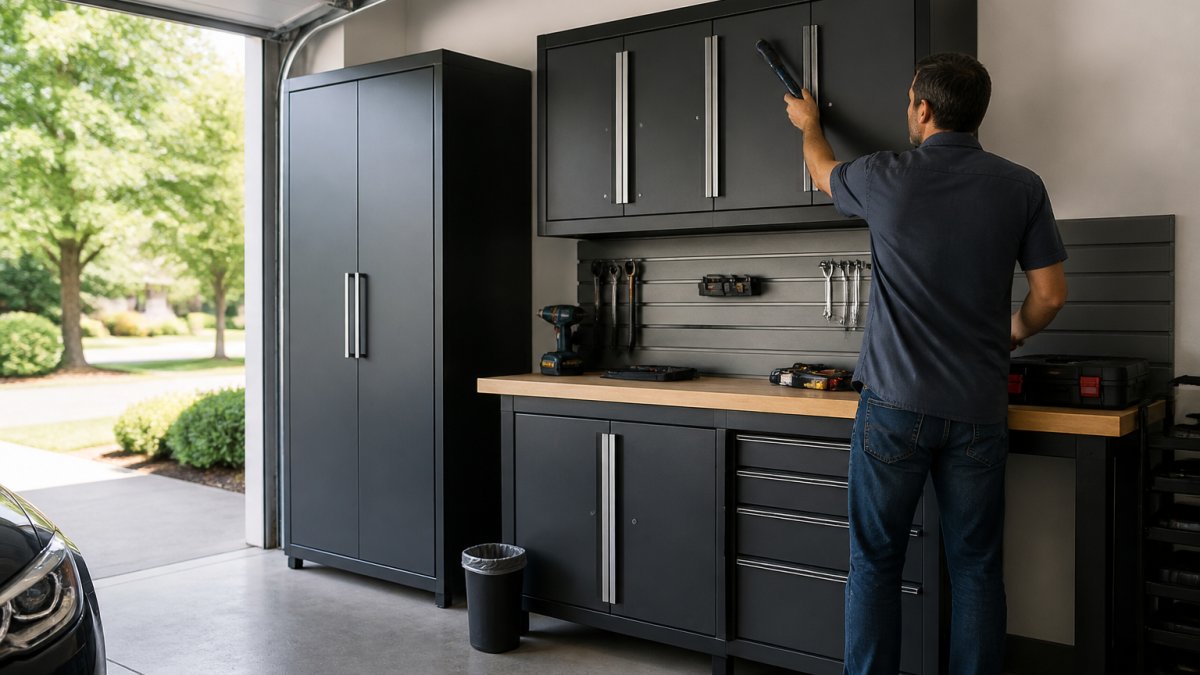
Garage: daily tool access and vehicle clearance
Best for: wall-mounted above a bench; freestanding along a side wall; mobile if you work around the car. Skip if: you need to move the cabinet regularly, choose casters from the start rather than adding them later.
Workshop: capacity, shelving, and heavy loads
If you are weighing a wall-mounted setup for a bench area, our lockable metal wall cabinet in charcoal grey fits that use case with an adjustable shelf and included wall brackets.

Best for: tall freestanding units with adjustable shelves; mobile cabinets for bench-side access. Skip if: you need maximum shelf count in a small footprint, wall-mounted units win there.
Warehouse and commercial: throughput and security
Best for: double-door cabinets with multi-point locks and reinforced shelves. Skip if: the cabinet will be moved between sites, bolt-together flat-pack units ship and reassemble more easily.
Office and light-duty: finish and footprint
Best for: mid-gauge cabinets with a clean finish and modest depth. Skip if: you are storing heavy equipment, step up to 18-gauge construction.
18-Gauge Steel Tool Storage: What the Gauge Number Tells You
This is the spec we build our tool storage around.
Welded vs Bolt-Together Steel Cabinets
| Construction | Strength | Assembly | Best For |
|---|---|---|---|
| Welded | Highest rigidity | Arrives assembled | Daily heavy tool storage |
| Bolt-together | Good when braced | Flat-pack, self-assembly | Tight access, budget builds |
Industrial Storage Cabinet Weight Capacity and How to Compare Load Ratings
Industrial storage cabinet weight capacity is the total load a cabinet is rated to hold, and shelf capacity is the load any single shelf can carry. Compare both numbers, because a cabinet rated for a high total can still have weak individual shelves. A common mistake is reading the headline figure and ignoring the per-shelf limit.
The Ready-To-Assemble GearBox holds up to 455 lbs per cabinet with 55 lbs per shelf.
Per-shelf versus total capacity: read both numbers
A cabinet's total rating is only reachable if the load is spread evenly across every shelf. If one shelf carries the heavy item and the others are empty, the per-shelf limit is the number that matters. When you compare two cabinets, divide the total rating by the shelf count to see the implied per-shelf figure, then check it against the stated per-shelf limit. If the stated per-shelf limit is far below the implied average, the frame is overbuilt relative to the shelves, useful for floor storage, less useful for shelf-heavy loads.
Evenly distributed versus concentrated loads
Load ratings assume an evenly distributed load across the shelf surface. A concentrated load, a single heavy tool box in the middle of a shelf, stresses the shelf far more than the same weight spread out. Most practitioners find that keeping heavy items toward the shelf edges and over the shelf supports, rather than dead center, reduces bowing. For concentrated loads, choose a cabinet with reinforced or double-rolled shelf edges and a rigid frame, and consider storing the heaviest items on the cabinet floor.
Choosing a safe margin
A common pattern is to plan for no more than about 70-80% of a shelf's rated capacity in daily use, reserving the full rating for occasional or evenly spread loads. That margin absorbs the difference between a static load and the dynamic load of setting a heavy item down, and it leaves room for the shelf to hold its shape over years of use. Exceeding a shelf's rating by even a little causes permanent bowing, and a bowed shelf never returns to flat.
Comparing ratings across products
When two cabinets look similar, compare four numbers side by side: total capacity, per-shelf capacity, shelf count, and shelf adjustment increments. A cabinet with a higher total but fewer, fixed shelves may hold less usable load than one with more adjustable shelves at a slightly lower total. Also check whether the rating is stated for the cabinet as shipped or for an anchored unit, tall cabinets should be wall-anchored before you load the top shelves, because an unanchored tall cabinet can tip before it reaches its weight limit.
Dimensions, Delivery, and Installation Planning
Measure the space, the doorway, and the delivery path before you order, because a cabinet that will not fit through the garage door is a return waiting to happen. Cabinet dimensions are listed as width by height by depth, and depth is the number buyers forget. A deep cabinet eats into parking space.
Wall-mounted units need solid anchoring into studs or masonry, and most ship with brackets included. Freestanding units need a level floor; adjustable leveling legs help on uneven concrete. Plan for assembly time on flat-pack models, and clear the delivery path before the truck arrives.
Security, Locking Systems, and Workplace Safety
Safety anchoring is the other half of the equation. Tall freestanding cabinets should be anchored to the wall so they cannot tip when a heavy drawer is pulled out. In a commercial setting, keep aisles clear and store heavy items low to reduce lifting injuries.
Pick Your Cabinet and Order It
Our steel garage cabinet is a freestanding 36 in. W x 42 in. H x 18 in. D unit with adjustable shelves, a three-point locking system, and ANSI/BIFMA compliance.

For a taller footprint, the Fortress 74.8 in. cabinet has three adjustable shelves and one fixed shelf behind two doors.
Frequently Asked Questions
What gauge steel is best for heavy duty cabinets?
Garage Mosaic builds its tool storage in 18-gauge steel.
Are welded steel cabinets better than bolt-together cabinets?
Welded frames resist racking better because the joints cannot work loose over years of vibration and humidity. Bolt-together cabinets ship flat and cost less to move, but the fasteners need periodic checking, and a loose bolt turns a square cabinet into a wobbly one. For a fixed workshop wall, welded construction is the sturdier choice. For a cabinet you plan to disassemble and relocate, bolt-together has the edge on portability.
How much weight can heavy duty steel cabinets hold?
The Ready-To-Assemble 3/4 Door Gearbox from Garage Mosaic holds up to 455 lbs per cabinet with 55 lbs per shelf.
Are heavy duty steel cabinets worth the investment for a home garage?
Garage Mosaic cabinets start at $169 for a wall-mounted unit and $299 for a freestanding 36 in. W x 42 in. H x 18 in. D model with a 3-point locking system.
What should I look for when buying heavy duty steel cabinets?
Check five things: steel gauge, shelf count and adjustability, per-shelf weight capacity, the locking system, and the finish. Measure your space and door swing before ordering, and confirm whether assembly is required. The Fortress 30.3 In. tall cabinet needs home assembly.
If your current storage has started to sag, warp, or rust, it is time to replace it with something built to last. Garage Mosaic offers 18-gauge steel tool storage, rolling cabinets, and wall-mounted units designed for real everyday use, with pre-loaded tool sets and garage lifestyle products to complete the space. Get started with Garage Mosaic and build a garage setup that stays organized for years.
