

Which Garage Storage Survives a Humid Climate?

Last Updated: October 25, 2026
Quick Summary
Sealed powder-coated steel cabinets are the most reliable humid climate storage, because a closed, gasketed door keeps damp air off the contents and the coating sheds surface moisture. Look for full interior and exterior coating, sealed seams, and feet or wall brackets that lift the unit off bare concrete. Measure your garage with a hygrometer first and fix the moisture source before buying.
- Keep a garage below roughly 60% relative humidity, with 40-50% as a comfortable target for tools.
- Bare steel can show flash rust within days when readings stay above 70% for extended periods.
- The Steel Garage Cabinet is 36 in. wide with adjustable shelves and a 3-point locking system for $299.
- The Fortress Metal Wall-Mounted Garage Cabinet at $169 gets tools off the floor behind a lockable door.
- The Ready-To-Assemble Gearbox holds up to 455 lbs per cabinet and can take casters.
Table of Contents
- Quick Comparison: Best Garage Storage for Humid Climates
- What Actually Fails in a Humid Garage
- Humidity-Resistant Garage Cabinets: Steel, Wood and What to Check
- Garage Storage Bins for Humid Climates: Lids, Airflow and What Goes Inside
- How to Reduce Humidity in a Garage Before You Buy Anything
- Protecting Tools From Rust in a Garage: Storage Habits That Work
- Long-Term Care: Corrosion, Mold and Maintenance Checks
- Choosing the Right Cabinet Setup for Your Garage Layout
- Frequently Asked Questions
Quick Comparison: Best Garage Storage for Humid Climates
Humid air rusts tool steel, warps particleboard, and grows mold on anything against an exterior wall. At Garage Mosaic, best garage storage for humid climates starts with sealed steel, elevated shelving, and a humid climate storage plan.
Below, we compare our humidity-resistant cabinets, then explain what fails in a damp garage and how to fix it.
| Cabinet | Material | Price | Best For |
|---|---|---|---|
| Steel Garage Cabinet (36 in. W) | Steel, 3-point lock | $299 | Floor-standing tool storage |
| Fortress 30.3 In. Tall Cabinet | Steel, 4 shelves | $579 | High-volume tool walls |
| Fortress Metal Wall-Mounted (single) | Metal, 1 adjustable shelf | $169 | Off-floor, small footprint |
| Fortress Metal 2-Shelf (set of 2) | Metal, lockable | $349 | Matching wall pairs |
| Fortress Textured Steel (set of 2) | Textured grey steel | $329 | Textured finish, pairs |
| Asti Wood Wall Mounted | E0-grade melamine | $449 | Warmer look, moisture-resistant board |
| Ready-To-Assemble Gearbox | Steel, 455 lb capacity | $329 | Mobile workstations |
What Actually Fails in a Humid Garage
Wood-based shelving, untreated carbon steel, and closed plastic bins fail first. Bare steel rusts, composite boards swell at cut edges, and sealed containers trap damp air inside with your tools.
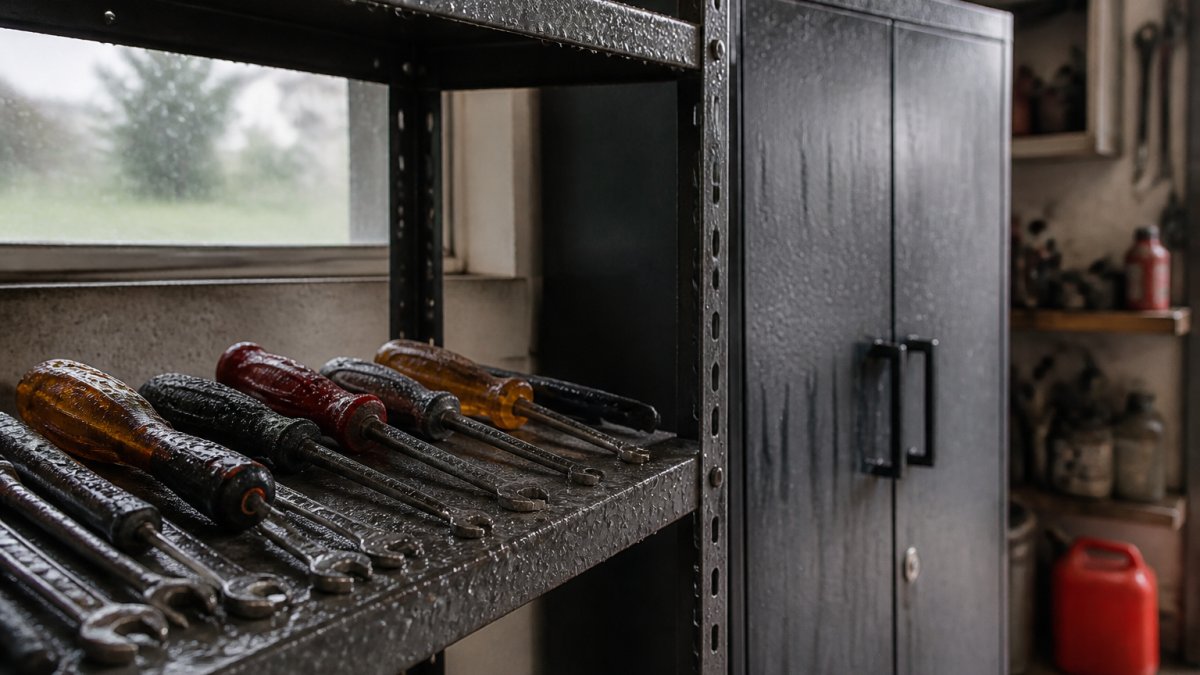
The fix is a combination of the right material, airflow, and a way to measure whether your garage is actually damp.
Condensation, Not Rain, Is the Real Enemy
Condensation forms when warm, moist air meets a colder surface, a steel shelf, a concrete slab, or a tool still cold from the night before. Most garage rust comes not from leaks but from daily temperature swings pulling moisture onto metal.
Humidity and Condensation Thresholds Worth Measuring
A cheap hygrometer tells you more than any product label. Many specialists suggest keeping a garage below roughly 60% relative humidity, with 40-50% as a comfortable target for tools and vehicles. Watch for readings above 70% for extended periods, that is when mold risk climbs and bare steel shows flash rust within days.
Humidity-Resistant Garage Cabinets: Steel, Wood and What to Check
Sealed steel is the most reliable cabinet material for humid conditions: powder-coated steel sheds surface moisture, and a closed door keeps damp air off the contents. But not all steel cabinets are equal, and the details that matter are rarely on the showroom tag.
Our cabinets and storage range covers both steel and wood options, so here is how to choose between them.
Steel Cabinets: What Separates a Humid-Climate Build From a Generic One
Steel is the default for damp garages, but finish and construction determine whether it lasts. Check these before buying:
- Coating coverage: A full interior and exterior powder coat or baked enamel, not just a painted door face, is the strongest indicator of corrosion resistance. Bare interior shelves rust first.
- Edge and weld treatment: Exposed weld seams and cut edges without coating are rust initiation points. Better cabinets have sealed or coated seams and folded edges rather than raw cuts.
- Door seal and closure: A closed, lockable door with a gasket or tight overlap slows air exchange far better than open shelving. A three-point locking system also pulls the door flush, which improves the seal.
The Steel Garage Cabinet is a solid starting point: 36 in. wide, 42 in. tall, with adjustable shelves and a 3-point locking system that keeps the interior sealed. For higher-volume tool walls, the Fortress 30.3 In. Tall Cabinet adds four shelves behind two doors.

Wood and Composite Cabinets: Where They Work and Where They Fail
Wood-based cabinets aren't automatically wrong for a humid garage, but board type and edge treatment decide the outcome.
If you prefer a warmer finish, the Asti Wood Wall Mounted Garage Cabinet uses E0-grade melamine with thicker ABS edge banding, which resists moisture far better than standard particleboard.
A wood cabinet mounted flat against a cold exterior wall traps condensation behind it, use a spacer or bracket so air moves behind the unit.
A Quick Material Trade-Off Summary
- Powder-coated steel: Best overall moisture resistance; sealed doors protect contents; heavier and can chip at edges if struck.
- Textured steel: Same corrosion behavior as smooth steel, with a finish that hides scratches and fingerprints; check that the texture is a coating, not bare metal.
- Melamine-faced board with ABS edging: Warmer look and adequate for wall-mounted use away from direct damp; fails faster than steel if edges are damaged or the unit sits on a damp floor.
What to Check Before You Buy
- Coating coverage: Full interior and exterior finish, not just the door face.
- Door seal: A closed, lockable door with a gasket or tight overlap.
- Feet or wall brackets: Anything that lifts the unit off bare concrete.
- Shelf adjustability: Raise shelves to keep items off the damp base.
- Load ratings: Match per-shelf and total capacity to what you store.
- Edge treatment: Sealed seams on steel; ABS banding on wood.
If you are comparing across categories, our buyer's guide to heavy-duty garage storage walks through load ratings and layout planning in more detail.
Garage Storage Bins for Humid Climates: Lids, Airflow and What Goes Inside
Lidded plastic bins protect contents from dust and splashes, but a sealed lid can trap moisture. Control what goes in and leave a small vent gap rather than sealing it airtight.
- Use clear bins so you can check contents without opening them.
- Add a desiccant pack to bins holding metal tools or electronics.
- Never store damp items: dry them fully before the lid goes on.
For items you check often, open wire shelving beats sealed bins because air circulates freely. The trade-off is dust. Match the container to the item: sealed for rarely used gear, ventilated for anything that might hold residual moisture.
How to Reduce Humidity in a Garage Before You Buy Anything
Lower the humidity first, then buy storage, otherwise you are organizing items inside a damp box. A humid climate storage plan needs to be measurement-driven.
Step 1: Measure Before You Change Anything
A cheap hygrometer, the kind sold for nurseries or reptile tanks, tells you more than any product label. Place it at mid-height, away from the door and off the concrete floor, and record readings morning and evening for a week to catch both the overnight condensation cycle and the daytime peak.
What the numbers mean:
- Below 50% relative humidity: Comfortable target for tools, vehicles, and stored goods. Maintenance mode.
- 50-60%: Acceptable for most storage, but watch metal tools and anything against an exterior wall. Improve airflow.
- 60-70%: Mold risk begins to climb and bare steel can show flash rust. Actively ventilate and consider dehumidification.
A common pattern: 55% on a dry afternoon, spiking past 75% overnight when the slab cools. That overnight spike, not the daytime average, is what rusts tools.
Step 2: Find the Moisture Source
Before buying equipment, identify where the moisture comes from. The three common sources:
- Groundwater wicking through the slab. Look for dark patches or efflorescence (white powder) on the concrete. A floor coating or vapor barrier helps, but only if the slab is dry enough to accept it.
- Air exchange with a humid outdoors. Open doors, gaps around the garage door, and unsealed penetrations let humid air in. Weatherstripping and a door seal reduce this.
- Roof or wall leaks. Less common than condensation but easy to confuse with it. Check for staining on the ceiling and walls after rain.
Step 3: Build a Moisture-Control Plan
- Ventilate strategically. Open doors on dry days and add a vent or fan for cross-flow; never ventilate on humid or rainy days. An evening exhaust fan flushes humid air that builds up during the day.
- Seal the slab if groundwater wicks through concrete. Test first: tape a square of plastic to the slab for 24 hours; condensation underneath means moisture is coming up through the concrete.
- Run a dehumidifier in the wettest months, sized to the garage volume. A slightly larger unit recovers faster after the door opens. Empty the tank or run a hose to a drain.
- Move storage off the floor onto wall brackets or legs. Cold air and condensation settle low, so the bottom 6-12 inches is the dampest zone.
- Keep gutters and drainage clear so water never runs toward the door.
- Re-measure after two weeks. If readings stay above 70%, add ventilation or a second dehumidifier before buying cabinets, otherwise you are sealing damp air inside a steel box.
A dehumidifier plus wall-mounted storage solves most of the problem before any cabinet upgrade. The Fortress Metal Wall-Mounted Garage Cabinet at $169 gets tools off the floor and behind a lockable door, but only once readings show the garage is dry enough.

Protecting Tools From Rust in a Garage: Storage Habits That Work
Rust prevention is mostly habit: wipe tools down after use, store them dry, and keep them in a closed cabinet rather than an open pegboard in a damp corner.
- Apply a thin film of tool oil to bare steel before long storage.
- Keep a silica gel pack in each drawer or cabinet section.
- Avoid storing tools directly against concrete walls.
The Fortress 30.3 In. cabinet offers three adjustable shelves plus one fixed shelf behind two strong doors, a sealed, lockable space for your most rust-prone equipment. The Ready-To-Assemble Gearbox holds up to 455 lbs per cabinet and can take casters, so you can wheel it to a drier spot.

Long-Term Care: Corrosion, Mold and Maintenance Checks
Corrosion and mold build slowly, then all at once. A five-minute monthly check catches both early.
Monthly checklist:
- Wipe condensation from cabinet tops and shelf edges
- Inspect cabinet feet and wall brackets for rust
- Check bin interiors for musty smell or damp
If you spot white powdery bloom on steel, wipe it with a dry cloth and apply a light oil. On wood cabinets, sand and reseal any swollen edge before it delaminates. Catching it early is the whole game.
Choosing the Right Cabinet Setup for Your Garage Layout
Match the cabinet to the wall, not the other way around. Measure your floor space, note where exterior walls sit, and keep the dampest wall free of solid-backed furniture.
A simple decision framework:
- Small garage, limited floor: wall-mounted cabinets, single or paired.
- Heavy tool collection: tall freestanding steel with multiple shelves.
- Mobile work area: a caster-ready cabinet you can reposition.
For a deeper look at heavy-duty options, our buyer's guide to heavy-duty garage storage walks through load ratings and layout planning. If your space is tight, this guide on how to organize a small garage covers placement and vertical storage ideas.
Frequently Asked Questions
What is the best material for garage storage in a humid climate?
Steel is the safer default for humid climate storage because it does not absorb water the way wood-based boards can. Look for metal cabinets with a durable finish and lockable doors, such as the Fortress Metal Wall-Mounted Garage Cabinet, which is built from metal that resists tarnishing. If you prefer a wood look, choose boards rated for moisture resistance, like the E0-grade melamine used in the Asti Wood Wall Mounted Garage Cabinet, and keep them off the floor and away from direct damp walls.
How can I keep moisture from damaging tools stored in my garage?
Start with airflow and containment. Store tools in closed metal cabinets rather than open shelves, wipe them down after use, and avoid stacking them against a cold exterior wall where condensation forms. A wall-mounted unit like the Fortress Metal 2-Shelf Wall Mounted Garage Cabinet keeps tools off the floor and behind lockable doors, which limits dust and damp air contact. Pair that with a humidity reading taken regularly so you know when conditions are drifting.
Should garage storage bins be airtight in a humid climate?
Airtight is not automatically better. Sealed bins keep moisture out, but if damp items go in, the lid traps that moisture against the contents. Use lidded bins for seasonal items and fabrics, make sure everything is dry before closing the lid, and leave ventilation gaps for anything that needs to breathe. For tools and metal parts, a closed steel cabinet is usually a better fit than a plastic box.
What humidity level is acceptable in a garage?
There is no single universal number, but as a working guide, keep relative humidity below roughly 60% and avoid sustained periods above 70%, where condensation and surface rust become far more likely. Measure with an inexpensive hygrometer placed at shelf height, not near the door. If readings stay high, improve ventilation and consider a dehumidifier before adding more storage.
Are metal garage cabinets better than wood in humid conditions?
For most humid garages, yes. Steel does not swell, warp or support mold growth the way wood-based boards can, and powder-coated or finished metal resists surface corrosion. Wood still works if it is engineered for moisture, like the melamine construction in the Asti cabinet, but it needs more attention to placement and ventilation. The deciding factor is usually what you are storing and how much standing damp the cabinet will see.
A humid garage will test any storage system you put in it. The answer is not a single product but a plan: measure the moisture, ventilate and dehumidify, then choose sealed steel cabinets that keep damp air away from your tools. Garage Mosaic builds cabinets for exactly that job, with 18-gauge steel construction, lockable doors, and adjustable shelving across the range.
Get started with Garage Mosaic and build a garage setup that keeps your tools dry, organized, and ready for real everyday use.
